|
The Goddess Venus in Mythology
Indulge Thyself!
 Roman Venus and
Greek Aphrodite Roman Venus and
Greek Aphrodite
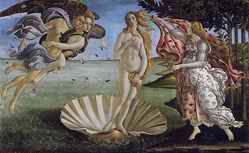
Roman Goddess Venus and the Greek Aphrodite are usually known for beauty, love and grace. Yet ironically,
the Goddess
of Love was born of violence. In Greek mythology, Aphrodite was born when Kronos
(Saturn in Roman mythology) castrated his father, Ouranos (Uranus),
whose semen fell into the ocean. From this, Aphrodite (Venus) instantly
rose full grown from the sea. The name Aphrodite comes from the Greek
aphros, which means the "sea foam" produced by the violent churning of the ocean waves. Although we use the Roman names for the planets, some
of the richest mythology and insight about the corresponding gods and goddesses come from the ancient Greeks. (At the bottom of this article you'll find a list of recommended books on Venus,
Astrology and Mythology.)
The Mayans and Aztecs of Central America also saw the planet Venus
connected to violence. They believed that when Venus goes retrograde,
she morphs from a woman into a man, gets seduced by the goddess of love
into tarnishing "his" purity, and fathers a sea monster child. Then "he"
loses in a ritual game of ball and must be sacrificed by the Sun, after
which "he" is reborn as a "she." This sequence was mirrored by the
Mesoamerican cultures through real-life competition, warfare and human
blood sacrifice leading to fertility rites. (For more about this
fascinating astrological system, read Bruce Scofield's
Signs of Time: An Introduction to Mesoamerican Astrology and
Day-Signs: Native American Astrology from Ancient Mexico.
Oh, Those Golden Girdles!
In modern day Western culture, we tend to focus on Venus' gentle side ― and who wouldn't! It's so
much easier to deal with someone who is diplomatic, fair minded,
beautiful, graceful, soft and sexy. To the Greeks, Aphrodite was the
goddess of sexuality, desire, love, joy and beauty. To the Romans, Venus
was originally an agricultural goddess of gardens and vineyards, and
later adopted more of Aphrodite's traits as these cultures merged.
Aphrodite/Venus is well known for her Magic Girdle or embroidered belt,
made of gold filigree crafted lovingly by her husband, the smith god Hephaestus/Vulcan.
When she wore it, she was irresistible! Other goddesses sometimes
borrowed this girdle when they wanted to turn on their love light. When
we wear the Girdle of Venus, we surround ourselves in an aura of love,
desire, beauty, magnetism and charm. This is the natural beauty of our
spirit that shines through, no matter what our physical appearance looks
like. (There is also an atmospheric phenomenon called The Belt of Venus,
in which the horizon glows pink just before sunrise or after sunset.)

When Bunnies Go Bad
Sexy
Aphrodite might be compared to a Playboy bunny, but she's no fluffy bunny! She was one of the central figures in
the terrible Trojan War, which began as a competition between Aphrodite, Hera and
Athene to determine who was the most beautiful. When Aphrodite
won, chaos ensued and the Trojan War resulted.
And she was not one to trifle with or ignore! In Greek mythology, anyone who
scorned her worship was struck with some kind of curse or perversion
from her domain. For example, Narcissus was made to fall in love with
his own reflection in a pool of water because he had belittled the love
from others. Anyone who spurned Aphrodite or preferred others over her
could be cursed with "unnatural passions," sexual misbehaviour, unrequited
love, tragic love and other similar forms of punishment. When we
disrespect the sanctity and importance of love and intimacy, the result
can be that we lose touch with our heart and therefore the Heart of
Life.
Follow Your Heart
Loyalty and fidelity were not high on her priority list, but following
her heart was. She was unhappy in her marriage to Hephaestus, who was
reportedly lame, weak and ugly. (She had not chosen him, but the
marriage had been arranged
by Zeus as a reward to him.) She had an affair with Ares/Mars and was caught in the act by her husband,
whose plea to the Olympian gods for justice was laughed off. Hephaestus
divorced her as a result.
Following one's heart is not without its
consequences, but without it we are only going through the motions that
are put on us by others. We have to make a choice ― to pay homage to
Aphrodite/Venus or risk the consequences of her wrath. Her central message seems to be: It is crucial to honour love above all
else. If you dishonour or disregard the workings of the heart, you will
eventually suffer for it.
Go to the Next Article in the Venus series >>
Go to the Article Index Page >>
Go to Top of Page ^
© 2005 Wendy Guy, All rights reserved. This
content may not be copied or used without the expressed permission of
the author.
|