Zodiac Sign
Aquarius
The
Communal
Self
I am he as
You are he as
You are me and
We are all together....
- John Lennon
 GROUP:
association, society, alliance, coalition, league, union, council, bloc,
federation, community, clan, totem, caste, fellowship, guild,
brotherhood, sisterhood, club, faction, sect, clique, circle, ring,
crew, crowd, ingroup, team, organization, institution, institute,
affiliation, chapter, membership, lodge. GROUP:
association, society, alliance, coalition, league, union, council, bloc,
federation, community, clan, totem, caste, fellowship, guild,
brotherhood, sisterhood, club, faction, sect, clique, circle, ring,
crew, crowd, ingroup, team, organization, institution, institute,
affiliation, chapter, membership, lodge.
INDIVIDUAL(ITY):
person, man, woman, child, elder, human being, mortal, soul, being,
entity, creature, critter, earthling, personality, body, somebody,
someone, one, fellow, chap, singleton, item, persona, single,
organism, life, object, aloneness, solidarity, singularity, integrity,
unity, oneness, solitude, detachment, seclusion, alienation, aloofness,
particularity, uniqueness, intactness.
"So what," you ask?
("Took the words right from
this horse's mouth...")
Just look at all the different words there are to describe an individual
and a group of individuals. And this is only a sampling! Clearly, the
English speaking world places high importance on these concepts, judging
from the quantity of the words.
The zodiac sign Aquarius is about
both the group and the individual; about our commonality within groups
and our individual uniqueness. From our initial perspective, it may seem
like these concepts are mutually exclusive, yet each is tethered
resolutely to the other. In honour of Uranus travelling through its
native sign, Aquarius, this article will extensively examine the
inter-dynamics of groups and the individuals that form them. By the time
we have concluded our trek through the land of Aquarius, it will be
difficult to tell them apart. ("That makes
sense (sort of); confusion and the unexpected are, after all, the territory of
Aquarius!")

Groups — The Macrocosm
The drive for
connection with other human beings is one of the most primal instincts
in human nature. We are social animals who exist in families, tribes,
villages and cities. We belong to circles of friends, synagogues,
churches, temples, workplaces, neighbourhoods, clubs and constituencies.
We seek out each other's company to share information, for mirroring of
who we are, and because, as a whole, the group can accomplish more than
its individual members alone.
A group is indeed
greater than the sum of its parts. Although composed of distinct, unique
individuals, a group will take on a life of its own and become an entity
in its own right. Like a river made up of many droplets of water, a
group of people will also contain currents, eddies, cascades and
shifting tides. Group dynamics rise out of the collective gestalt, much
as psychological impulses spring from an individual's psyche.
("Is THAT what that is! I keep
having to wipe the stuff off...")
Within a collective
context, a person may behave differently than s/he would as a separate
individual. If we believe our group approves of and supports certain
behaviour, we are more likely to emulate that behaviour rather than risk
alienation and disapproval. If we think the group disapproves of or
discourages certain actions, then we are more likely to avoid those
actions (especially within that group). This may even happen despite our
personal beliefs, values or better judgment. Peer pressure is a mighty
force to be reckoned with!
Our first experience
of the need to belong comes to us in childhood, in our family of origin.
Here, belonging was, at its most crucial level, a life or death prospect
in which our very survival depended on being accepted as a member in
good standing with our family. To deviate from the family's good graces
was to risk abandonment, isolation, rejection and disconnection. Hence,
we conformed to a large degree to our family's expectations and set our
inner compass according to the family group dynamics — often without
even realizing it.
As adults, we have
options that we didn't have as children. We can take greater risks
asserting our individuality, since abandonment and rejection don't bring
the same life or death consequences. However, we're still subject to the
intense human need to be accepted and esteemed by our community. We
still depend on our environment for our livelihood, companionship,
mirroring, intimacy and commerce. It's extremely difficult to live as a
hermit, particularly if we still want the advantages and perks offered
by the collective society. ("Aaah! Happiness
is a warm keyboard...")
This can lead to
awkward, even painful consequences if we do something that leads to
alienation from mainstream society or from our groups of choice.
Rejection is one of the chief fears that motivate human beings, be it by
one's family, friends or community at large.
("Ya, I always feel hurt when Mercury retrograde
makes my harddisk do hiccups and my Human screams
four-letter words at me!")
We all need to belong and are thus prone to
compromising our ethics, morals, beliefs, opinions or
integrity when our well being within the group is at
stake. We may look the other way when something seems
amiss, afraid that if we speak out we'll become a target
for criticism. Perhaps we want to avoid rocking the
boat, so we agree on the outside when we really disagree
inside, our dissention being camouflaged by silence. Our
complicity in group dynamics can occur in many ways.
The Scapegoat Scenario
If we do risk
speaking out or go against the grain for some reason, we may have to
endure criticism, rejection, alienation, disconnection or banishment.
Depending on how much our dissension is seen as a threat to group
cohesion, the response may be mild or severe, evoking anything from
raised eyebrows to outright retaliation. ("Ya — if you fart in public, you get the old hairy eyeball stare. But if
you strangle the person who gives you the weird look, they lock you
up!")
It is within this
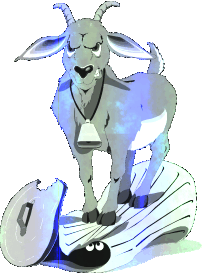
breeding ground that scapegoats are born — one of the uglier dynamics
that can emerge in groups. The original meaning of a scapegoat was
apparently a ritual in which the townspeople would project the problems
of the village onto a goat, then set it away, believing it would carry
their problems with it. I suspect that if the people were truly ready to
let go of the dynamics which fostered their problems, such a ritual
could have a powerful effect. However, if this action was merely out of
desperation and the root dynamics of the problems and conflicts remained
firmly entrenched, such a ritual would be unlikely have much effect in
the long run. ("Except to waste a perfectly
good goat!")
In terms of group
dynamics, scapegoating is typically a function of the group's attempt to
rid itself of a persistent problem by ejecting the person(s) they
believe to be the source of the problem. Such a person can find
him/herself the target of increasing and intense criticism, disapproval,
alienation and hostility, whether deserved or not. Perhaps the most
horrendous example of the scapegoating dynamic is that of the holocaust,
in which millions of Jews and other "social undesirables" were
strategically exterminated. Hitler lead a movement which saw Germany's
problems as being the fault of an "impure" populace. The result was
genocide at its worst.
Another example of
what I believe to be scapegoating, this time in modern day Ontario,
Canada, is Premier Harris' policy of blaming those who partake of social
programs for today's economic problems. ("Ah yes, our
nefarious — I mean notorious — I mean illustrious Premier!")
Many Ontarians feel Harris has become overzealous in the speed and
degree of cutbacks; that he is targeting not the source but the symptoms
of the problem.
When there are few
jobs to be found, are the unemployed who collect welfare and
unemployment insurance the cause or the result of the root problem? When
those who are barely physically mobile, or who must remain attached to
cumbersome medical equipment in order to survive, are refused the
renewal of their right to Wheel Trans (transit for the physically
disabled), forcing them to remain effectively house bound, is the
provincial government not attempting to rid itself of its economic woes
by penalizing those who least deserve and can ill-afford to shoulder it?
These actions are frequently called "blaming the victim," assigning
blame to those who can least defend themselves.
Unfortunately, the
Harris government appears to genuinely believe that by eliminating much
of the funding to these sub-groups (unemployed, disabled, etc.), the
economic problems of the larger group (Ontario residents) will be
solved. Despite mounting protest, there are those who continue to
support the actions of this government. Many of these people may not be
affected by the government's cutbacks or be aware of other causes of our
current economic problems (shifting tax structures, automation, NAFTA/free
trade). ("the rising cost of Goat
Chow...")
On a more individual and astrological level, the
experience of being alienated from the group for reasons
beyond one's control can be painfully familiar to
someone with strong Aquarius energy in their chart. For
the rest of us, the houses where Uranus and Aquarius are
found in our charts, as well as the 11th House, may be
where we feel like outsiders (estranged and detached
from the rest of the group) or where we feel
particularly connected to the group (e.g., participate
in group activities).
 Getting Your Goat (Back) Getting Your Goat (Back)
Once a current
swells within a group to flush away its problems by citing one or more
people as the cause, it is very difficult to turn this tide. It takes a
heroic effort of awareness, objectivity and openness to a balanced
perspective, on the part of the group's members, to stabilize the panic
of scapegoating with an attitude of reason, impartiality, fairness and
humanity.
Unfortunately, there
are few individuals and fewer groups who are capable of sustaining this
balance in the face of compelling peer persuasion. Hence, it is probable
that few groups are able to stem the tide of scapegoat ism once it has
begun. Even voices raised in objection can be lost in the dominating
energy. (Witness how little the mounting outrage and protests in Ontario
have affected the Harris government's momentum.)
Group problems
rarely, if ever, originate from a single individual.
("What a shame. I always wanted
to have that kind of power over a group of people...")
Group dynamics are very complex and are almost never at the mercy of a
single individual's influence. No one can control a group without its
members' consent, whether that permission is granted passively (apathy,
bewilderment, indifference, etc.) or actively (supporting and defending
the leader's vision and policies, etc.). Problems within the group are a
function of the holistic group dynamic — not that of one "problem"
individual.
Even in the event that one person contributes a singularly negative
influence, it is still the deeply underlying group dynamics that provide
a breeding ground for specific problems to flourish to the point of
crisis.
Scapegoat-ism is
ultimately a polarization between the group's leader(s) and the
scapegoat. The group current could flow in favour of either pole,
probably depending on where the power is seen to reside. The leader's
mandate may be questioned and the scapegoat may become the Underdog ("—Another Aquarian word! They
get all the good words, it's not fair!!!"),
which the group rallies to protect. This may, in turn, focus the leader
as the group's next scapegoat, that person now being seen as the new
cause of their problems.
One example of this, I believe, is the recent pattern
of erratic election results in Ontario. Voters have
swung from one political extreme to another, which I
believe is a result of desperation combined with intense
disillusionment. As one political leader fails to
eradicate our persistent problems, s/he falls from grace
and is seen as reprehensible. The vehement banishment of
one leader gives rise to an (apparently) overwhelming
mandate for the next alternative.
Whose Authority?
This illustrates the
function of Saturn in the Aquarian archetype. The Capricorn side of
Saturn represents our struggle to claim our own authority; to set our
own rules and make our own decisions. In Aquarius, if we have not
mastered this task, we may become meek followers or overzealous leaders,
neither of whom will be capable of tolerating healthy dissention or
diversity within the group — something a healthy group must allow for.
Ideally, we are meant to bring ourselves to a group as
fully-functioning, autonomous individuals, or else we'll be vulnerable
to the will of the group conscience — which may or may not be in our
best interests or the group's.
If a group's members
chronically resist embracing their own Saturn energies, that function
will probably become projected onto the group itself and/or its leader(s).
("OR onto us mythological
sitting ducks! ...or horses, as the case may be...")
Saturn then becomes a force compelling individuals to rigidly conform to
the group agenda, allowing little flexibility for individual
preferences, needs or variation. The group as a gestalt could become
tyrannical, fanatical, erratic or scattered.
And in such an
atmosphere, woe betide the person who dares to stand up and declare,
"There's something wrong here!" Such a group is founded on rigid
conformity and protective defence of its dysfunctionality. Any opposing
voices intent on introducing a healing, functional energy are likely to
be perceived as threats to the group and could possibly become targets
or scapegoats. Such an attack is ostensibly a protective mechanism of
the group, designed to preserve what is held to be its only workable
structure.
A healthy,
functional group, on the other hand, can withstand differing views
within its membership. (("If Groucho Marx denounced any
group who would have HIM as a member, then I think I'm in trouble...")
Its cohesion is not dependent on compliance, so much as on a common
thread running through its membership. It requires that its members have
a shared bond within their individuality, not be like clones who all nod
"yes" on cue. A healthy group will also be able to deal with new ideas
and directions — growth and change are constants that affect groups as
well as individuals.
This is essentially the difference between the roles
of Saturn and Uranus in the Aquarian drama. At its best,
Saturn builds self-authority in the individual and
cohesion in the group; Uranus brings a holistic
flexibility to the group and the qualities of
risk-taking and disclosure of personal perspective to
the individual. At its worst, Saturn promotes rigid
conformity in the group and blind obedience in the
individual; Uranus sparks erratic swings and
fragmentation in groups, while sparking rebellion and
reactivity in the individual.
a href="#">
The Individual
— the Microcosm
We in the western
world pride ourselves on being individuals — unique, independent,
insulated from the prescribed influence of others. We see ourselves as
self governing — free to think, feel and do according to our distinctive
uniqueness. Our culture values this quality and tends to see those who
are open to the influence of others as weak, naive and simple.
But are we actually
capable of being truly autonomous individuals? As already discussed,
each of us is instinctively compelled toward membership in at least one
group. Even a hermit once belonged to a family, and even if s/he
deliberately leaves that family, s/he continues to be a member in
absentia of that group. The hermit living in isolation may instead have
an intimate connection to the community of wildlife around him/her.
("Hey — who ya callin' wildlife?!
Oh well, I guess I've been called worse...")
Modern psychology is
founded on the premise that we are receptive, responsive beings who are
indelibly shaped by our early childhood environment, its effects carried
into adulthood in one form or another. Similarly, sociology is based on
the supposition that we are permeated by and reflected in the groups we
align ourselves with, be they families, friends, co workers, political
parties, religious groups, clubs, neighbourhoods, countries or cultures.
Clearly, we are much
more than separate specks adrift in a cosmos of other specks.
("—In your opinion...")
One's identity as an individual is very complex, composed not only from
conscious and unconscious personal thoughts and behaviour, but also from
associations with others. Whether this is with a single other person
(one to one relationship) or a group of people, we are influenced by
those alliances in ways we're often not aware of.
We learn from
others, are persuaded by others, are motivated and spurred into action
by others. We may intersect through our interest in astrology, or our
membership in an organization; through our love of movies, or an
enjoyment of skating. We may share philosophical ideas or religious
beliefs. We might all be friends of "so and so" or perhaps we live in
the same neighbourhood. ("I knew an old so-and-so
once...")
Resonating To The Whole
Whatever the groups
we belong to, we are all aligned with many groups for many reasons, and
each one plays a part in defining and reflecting who we are as
individuals. A person who belongs to an astrology group is revealing
something about him/herself that may not be shared by someone who
belongs to a fundamentalist religious group. A member of the Progressive
Conservative Party is actualizing some part of who they are, as is
someone involved with the New Democratic Party.
When we first enter into something new, we may
start it for one reason, but later continue with it for another reason.
("Excuse me, but did you just put
on the wrong reel or something??? What the Hades are you talking
about?!") For example, someone
might initially join Alcoholics Anonymous to stop drinking, but keep
attending meetings to meet a deeper, spiritual need. A person may return
to school in order to fill spare time, but later discover that s/he has
a need to learn something that will give him/her a new passion in life.
In the same way, the
surface reasons we have for aligning ourselves with a group might be
only the tip of the iceberg, compared to the underlying motives that
keep us connected to it. Our involvement with a group alters our
perspective, shifts our direction and permeates our thinking. As we
settle into a familiar rhythm with that group's standards, norms,
rituals and dynamics, we will either leave it, deciding it's not for us,
or we'll grow increasingly consistent with its agenda, philosophy and
patterns. (("You'll never see ME becoming
more like a Human!")
For example, as we continue to attend a bible study
group at our neighbourhood church, we'll likely adopt
much of its outlook and become more religious, as we
integrate our group experience into our personal
worldview. We "resonate" with the collective
consciousness, attuning our perspective to that of the
group like a piano string vibrates to the sound of a
tuning fork.a href="#">
Peer Power
Given this
vulnerability to group influence, how autonomous is the individual in
the broader perspective? Certainly we are more than mere pawns of the
group conscience, but we are also more than disjointed pieces that
coincidentally form a whole. We have social, mental, spiritual and
emotional tendrils that reach out and become intertwined with those of
others in other groups. And, just as the group is greater than the sum
of its parts, each individual is greater than the sum of his/her
alliances. ("But only if you add it up using
my special software!")
This is part of what
makes us unique — no one else has exactly the same collection of
associations as we do; and even if they did, our experience within those
groups differs. On the other hand, our affiliations also bring our
individual integrity into question — if we are moulded and swayed by our
involvement with groups, can we trust that our decisions and beliefs are
our own, or have we been mesmerized by the dynamics of the group?
Noam Chomsky,
linguist and political dissident, has written about a phenomenon he
calls "manufactured consent." This term refers to the idea that our
opinions and beliefs can be and are manoeuvred by those in authority to
suit their needs and support their agendas. This theory indicates that
we can be manipulated, not only to agree with someone, but also to
believe it's our own decision made from free will. ("It took a theorist to figure
that out??? Hades! Women have been accused of doing that to men for
centuries!") Chomsky's theories
describe a deliberate intent on the part of the leaders and movers of a
so called democratic society to fabricate a consensus. However, I
believe the same concept can also be applied to the subtle influences of
a group upon the individual.
Chomsky's idea casts
a sceptical light on the validity of what we believe to be our autonomy
and independence. His theory draws into question the extent to which we
know our own minds and challenges the western bravado that maintains we
are self governing beings rooted in free will. On the contrary,
Chomsky's concept of manufactured consent suggests that even as "free
thinking" adults, we are capable of being manipulated by group
conscience, particularly when met with apathy or ignorance.
(("Well I've never been apathetic
in my liF.... Aw nuts, who cares...")
However, by identifying and naming this dynamic, Chomsky's work implies
a belief that it is possible to transcend our susceptibility and take
outside influences into account when forming our decisions, beliefs,
values and direction.
Despite our intimate, symbiotic connection to group
dynamics, there is always that spark of individual
uniqueness and vitality that enables us to be more than
manipulated automatons. This spark keeps us moving
toward growth and evolution, at both the individual and
group level, yielding new perspectives and new
alliances. Our Uranian spark stirs up the melting pot of
our individual awareness and the global gestalt. a href="#">
The Aquarian Agenda
This rather
expansive discussion of group and individuality issues is meant to
illuminate a fundamental principle associated with Aquarius. The
upcoming New Moon cycle brings us into the Aquarian arena where we can
confront the issues of fate versus free will, liberation versus
subjugation, and individual versus group consciousness.
("And, in my case, mythical
versus mechanical!")
Uranus, the planet
of spontaneity and liberation, can also facilitate blind reaction and
erratic behaviour. When we resist a conscious perception of what we're
reacting to, we need to question how much our responses are the fruit of
personal individuation, and how much they have been unconsciously
manipulated by a larger, group-based dynamic. Uranus would have us
expand and stretch our perspective to encompass a vast, multifaceted
awareness of ourselves and the world around us.
Aquarius challenges us to expand our awareness to include
these paradoxical, complex, multi faceted perspectives of
ourselves as group members and individuals. It is not a case of
choosing one over the other — we are all of them! We are not
called upon to eradicate one and fervently grasp the other —
rather, Aquarius would have us strike a balance between them,
accepting ourselves as social beings that need group contact, as
well as islands: entities unto ourselves. The Aquarian agenda is
to bring us to a superior awareness as communal beings who are
ultimately capable of making wiser choices based on a
humanitarian acceptance of our human uniqueness as well as our
commonality.
© 1997, 2004, 2005
Wendy Guy. All rights reserved. Reprinted with permission from Transitions
Astrology Newsletter, Capricorn-Aquarius-Pisces 1997 Issue. |
|
|
"There
are a vast number of people who
are uninformed and heavily propagandized, but fundamentally
decent.
The propaganda that inundates them is effective when
unchallenged, but much of it goes only skin deep.
If they can be
brought to raise questions and apply their decent instincts and
basic intelligence, many people quickly escape the confines of
the doctrinal system and are willing to do something to help
others who are really suffering and oppressed."
-
Noam Chomsky
From the DVD: Manufacturing Consent - Noam Chomsky and the Media
|
|
Beginner-plus/Intermediate Level Astrology Reading:
Alive & Well with Uranus
Transits of Self-Awakening
by Bil Tierney
Arise to the Awakener! Uranus,
the modern planetary ruler of Aquarius, wakes us up to
the essence of who we are, both in the natal chart and
by transit. Author Bil Tierney always has a wonderful way of
explaining things with clarity, wit and insight.
|
|
Weird and Wonderful
Astrology-Related Reading:
Pronoia Is the Antidote for Paranoia!
How the Whole World Is Conspiring to Shower You with Blessings
by
Rob Brezsny
When you feel like a "stranger in a strange land"
it's time to GET RADICAL!!
This is unlike any other book you've ever seen!
Crammed full of free-association insights, diagrams, illustrations,
irreverent surprises, rambling
viewpoints and radical perspectives.
If you long to spring out of the same old
ways of looking at life, and try on some new ideas, this is the book for
you! By the innovative writer of the Free Will Astrology horoscopes.
|
|
"The alienation that is at the centre
of much of western culture � the estrangement, the anxiety that
is there � is, in fact, the result of taking the individual out of
the circumstances of the world and not realize how deeply
implicated we are in everything that happens around us."
-
Bruce Powe,
Canadian author |
|